


Figurative Language in Writing: How Small Word Choices Transform a Student's Work


QUICK ANSWERFigurative language, such as metaphor, personification, and sensory imagery, lets a writer show a feeling instead of naming it. The real skill is not memorising literary devices, it is making deliberate word choices, replacing very scared or very dark with one precise image. Below are before-and-after figurative language examples from real Grade 9 writing, with what parents and teachers can look for. |
One thing I notice repeatedly in my Grade 9 Honors ELA classes is that students often know far more about English than they actually use in their writing. They know what a metaphor is. They know what personification means. They can identify a simile, underline sensory imagery, and explain what the writer is doing.
And yet, when they are asked to write their own narrative or descriptive paragraph, the writing can suddenly become very literal. The character is very scared. The room is very dark. The rain is very heavy. The girl is very nervous.
Nothing is technically wrong with these sentences, but they do not give the reader much to experience. These are exactly the kinds of weak, overused words I ask students to retire, the banned words that quietly flatten writing. Replacing them is where figurative language becomes much more than a list of devices to memorise for a test.
When Knowing the Technique Is Not Enough
I often tell students that knowing the name of a technique is not the same as knowing how to use it. A student can tell me, this is personification. But can they use personification to make an ordinary setting feel threatening? They can define a metaphor, but can they create one that reveals something about a character?
In my one-to-one online English classes, I can slow this process down. Instead of simply correcting a sentence, I ask: what do you want your reader to feel here? Can you show that feeling instead of naming it? Why did you choose that particular image? Those questions lead to stronger writing than telling a student to use more figurative language. Here are three students, and the writing challenges I see most often in creative writing for Grade 9.
Deeya: When the Ideas Are There, but the Writing Feels Flat
Deeya understands the assignment. She can organise her ideas and write grammatically correct sentences. The difficulty is that her first drafts can sound like she is reporting what happened rather than letting the reader experience it. Describing a storm, her first instinct might be: the storm was very scary, it was raining heavily, and the girl was frightened.
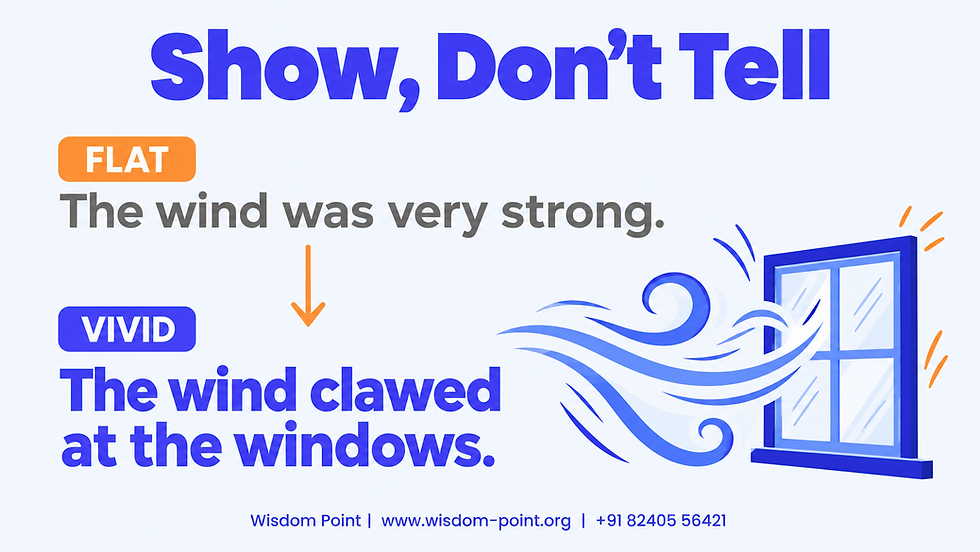
There is a clear idea there. But as a writer, Deeya can do much more. Instead of telling the reader the wind was strong, what if the wind behaves like something alive?
Flat: The wind was very strong and the storm was very scary. Vivid: The wind clawed at the windows, refusing to let the house sleep. |
Suddenly the weather has a personality. The storm feels aggressive, the house feels vulnerable, and the reader experiences the scene. This is where personification, sensory imagery, and precise verbs become tools for descriptive writing. The goal is not to make the sentence fancier. It is to make the image more precise and purposeful.
If your child's writing is correct but feels repetitive or flat, the issue may not be grammar at all. It is often a sign they are ready for the next stage of craft, the same shift I describe in why kids write weak sentences. One useful question changes an entire paragraph: what could the reader see, hear, or feel instead of being told what happened?
Harini: When One Image Does More Than Five Adjectives
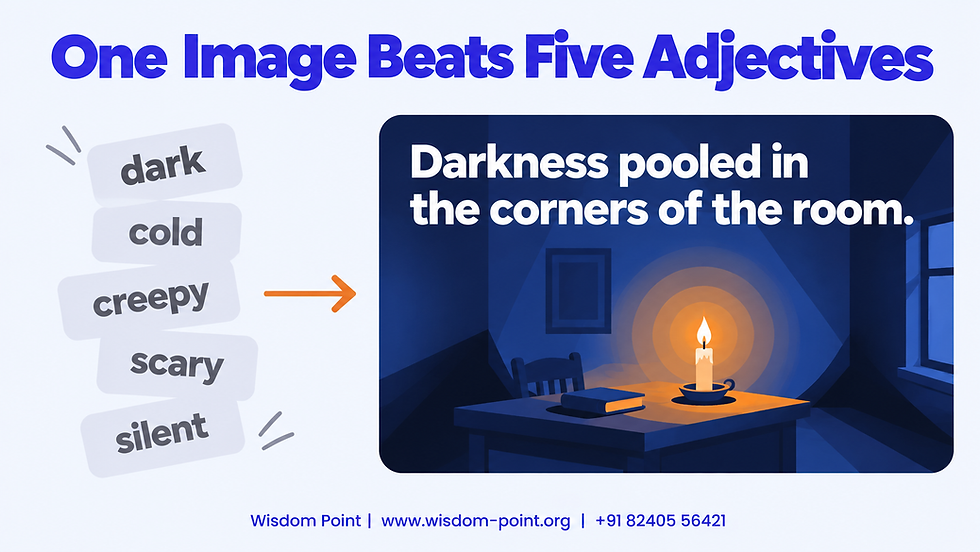
Harini has the opposite challenge. She often has plenty of ideas, and puts too many into one paragraph without giving a single image room to matter. She writes: the room was dark, cold, creepy, scary, silent, and mysterious. She is trying to create atmosphere, but the writing becomes a list.
So instead of adding another adjective, I ask: can you give me one image that makes me feel all of that?
Flat: The room was dark, cold, creepy, scary, silent, and mysterious. Vivid: Darkness pooled in the corners of the room, swallowing everything the weak candlelight touched. |
Now the darkness is not simply dark. It is doing something. That one choice creates atmosphere, and it introduces metaphor and personification without forcing a device in because a worksheet demanded it. Strong descriptive writing is not about using more words. It is about choosing better ones. If a child uses many adjectives but the writing still does not feel vivid, the better move is often to remove three ordinary descriptions and replace them with one strong image.
Lioni: Knowing Literary Devices vs Knowing Why to Use Them
Lioni can explain the terminology extremely well. Metaphor: a comparison that says one thing is another. Personification: giving human qualities to something non-human. Symbolism: when an object represents something beyond its literal meaning. That is excellent academic knowledge. But creative writing asks a different question: why this technique, here?
Suppose a student is writing about a character who feels trapped. They could write, he felt trapped. Or they could write:
Flat: He felt trapped. Vivid: The walls seemed to lean closer every time he breathed. |
The second sentence is not simply using personification. It reveals the character's psychological state through the setting. That is where literary technique becomes meaning. I want students to stop thinking which literary device can I add, and start thinking what do I want this sentence to reveal. This matters most for students who score highly when asked to identify literary devices, yet whose own narrative writing still sounds basic. They have the knowledge. They have not yet transferred it from analysis to application, which is one of the biggest transitions in Grade 9 English.
Figurative Language Examples: Show, Don't Tell in Action
These three students point to the same idea: figurative language is not decoration. A metaphor is not there because a teacher wants to see one. These techniques matter because they let writers communicate what plain language sometimes cannot. Here are two more before-and-after examples of show, don't tell at work.
Flat: She was nervous. Vivid: Her fingers worried the edge of her sleeve until the fabric began to fray. |
Flat: The old house was frightening. Vivid: The house watched from the end of the road, its broken windows staring into the darkness. |
The vivid version does not tell the reader the feeling. It gives evidence, and the reader makes the connection. That is show, don't tell working alongside characterisation and sensory detail. A good writer chooses the right tool for the right moment, which is why I ask students to treat literary devices as tools, not ornaments.
What Parents Can Notice in Their Child's Writing
If you are wondering whether your child needs more support with creative writing, look beyond grammar and spelling. Ask yourself a few questions. Does my child lean heavily on words like nice, scary, sad, happy, big, or beautiful? Does their writing tell me what happened but not help me experience it? Do they know literary terms but rarely use them naturally? Do their paragraphs hold many adjectives but few precise verbs? Do they find it hard to create atmosphere, or to show a character's emotions through action?
These are not signs that a child is bad at English. They are usually signs that the student is ready for the next stage of writing development. Sometimes what they need is not more vocabulary lists, but the chance to experiment with language, and someone to ask, what else could this sentence do?
What Teachers Can Do in the Classroom
Even small exercises help students move from recognition to application. Instead of asking students only to identify a metaphor, ask them to write one. Instead of asking them to underline sensory imagery, give them a plain sentence and ask them to transform it. Instead of saying use figurative language, give them a purpose: make the setting feel threatening without using the words scary, frightening, or dangerous. Now the student has to make a decision, and that decision is where the learning happens.
This is also where one-to-one creative writing tuition helps, because the teaching can begin with the child's own writing rather than a generic list of techniques. One student needs help with imagery, another with characterisation, another knows every term but struggles to apply it. The same principle runs through all my writing work, from the day I started banning weak words in class to the way we build precise, vivid sentences now.
From Knowing English to Controlling Language
The most rewarding moments in teaching creative writing are small. A student changes one verb. Replaces one adjective with an image. Turns a statement into a metaphor. Adds one sensory detail. Removes a sentence that explains too much. And suddenly the paragraph feels different.
Writing improves when students stop asking what technique should I use, and start asking what do I want my reader to experience. That shift, from identifying techniques to controlling language, is one of the most important developments I see in Grade 9 Honors ELA. Because sometimes, changing one sentence does not just improve the sentence. It changes the entire level of the writing.
Figurative Language: Frequently Asked Questions
What is figurative language?
Figurative language uses words beyond their literal meaning to create an image or a feeling. Common types include metaphor, simile, personification, and sensory imagery. Instead of stating a fact, it shows an experience.
Why is figurative language important in writing?
It lets a writer show an experience instead of naming it, so the reader feels the scene. The wind clawed at the windows does far more than the wind was very strong. It turns a flat sentence into one the reader can picture.
What are some examples of figurative language?
Personification: darkness pooled in the corners of the room. Metaphor: the walls seemed to lean closer every time he breathed. Sensory imagery: her fingers worried the edge of her sleeve until the fabric began to fray. Each shows a feeling rather than stating it.
How can I help my child use figurative language in writing?
Ask one question: what could the reader see, hear, or feel instead of being told what happened? Then have them replace three ordinary adjectives with one strong image. Small, repeated choices build the skill faster than any list of devices.
What is the difference between figurative and literal language?
Literal language states something directly, such as she was nervous. Figurative language shows it through comparison or image, such as her fingers worried the edge of her sleeve until the fabric frayed. The reader infers the feeling.
How do you teach show, don't tell?
Give a plain sentence and a clear purpose, for example, make the setting feel threatening without using the words scary or dangerous, and let the student transform it. The constraint forces a real language choice, which is where the learning happens.
KEY TAKEAWAYS Figurative language is a tool for meaning, not decoration. The skill is choosing the precise word or image, not adding more adjectives. Replace very plus an adjective with one strong image or a precise verb. Show a feeling through action and detail instead of naming it. Grade 9 is where students move from identifying devices to using them with intention. |
WORK WITH US AT WISDOM POINT If you recognise your child in Deeya, Harini, or Lioni, this is the exact work we do at Wisdom Point. In one-to-one online creative writing classes, we start with your child's own writing, not a generic list of devices, and ask the questions that move them from correct to vivid. We teach the metaphor, then use it. We name the feeling, then show it. To see whether this is the right next step for your child, book an assessment at www.wisdom-point.org or call +91 82405 56421. Let us help your child move from knowing English to controlling language. |
Warmly,
Premlata


Comments