


Formal Letter Format: Step by Step with Examples

WISDOM POINT · STUDENT WRITING FORMATS

QUICK ANSWER A formal letter follows eight parts in order: the sender's address, the date, the receiver's address, a subject line, a salutation, a body of three paragraphs, a complimentary close, and your signature. Open with Dear Sir or Madam and close with Yours faithfully if you do not know the name. If you know the name, open with Dear Mr Brooks and close with Yours sincerely. |
The formal letter is one of the oldest and most tested pieces of writing a student will learn, and it still matters today. It is how you apply, request, complain, or enquire in an official setting, and examiners across the world expect students to know its exact layout. At Wisdom Point, we teach the formal letter carefully, because a single misplaced part can cost marks even when the content is strong.
This guide breaks the formal letter format into eight clear parts, shows you how to write one step by step, and gives two full examples. You will also find tips, common mistakes to avoid, and answers to the questions students ask most. The layout is cross checked against the major curricula so it works wherever your child studies.
What Is a Formal Letter?
A formal letter is an official, structured letter written to someone you do not know personally or to a person in authority, such as a principal, an editor, a manager, or a government office. The tone is polite and professional, and the layout follows a fixed order that the reader expects.
The Formal Letter Format
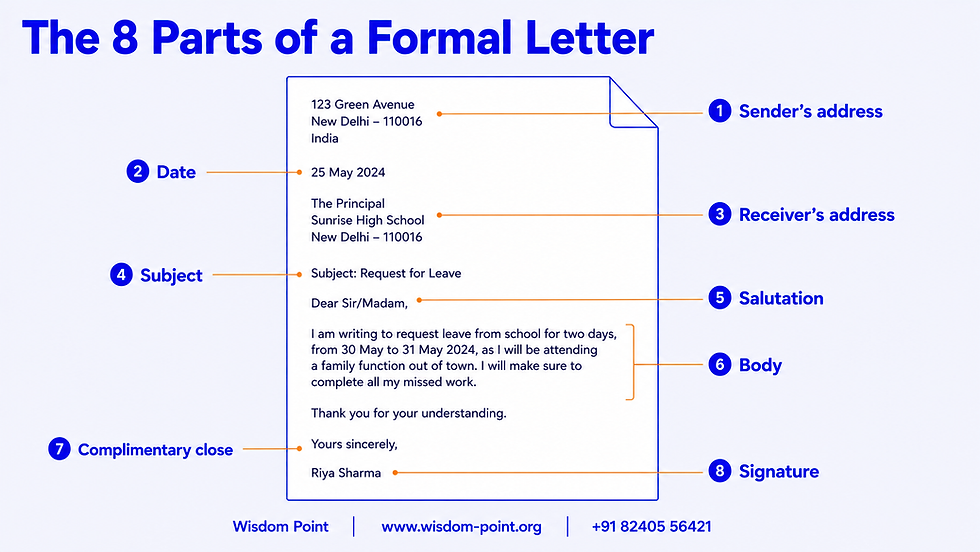
Every formal letter is built from the same eight parts, always in the same order. Learn this sequence and you can write any formal letter with confidence.
Part | What it is | Example |
1. Sender's address | Your address, top left, each line separate. | 15 Willow Lane, Brookfield |
2. Date | Below the address, written in full. | 9 June 2026 |
3. Receiver's address | The recipient's designation and address. | The Principal, Brookfield School |
4. Subject | One line naming the purpose. | Subject: Request for Permission |
5. Salutation | A respectful greeting. | Dear Sir or Madam, |
6. Body | Three paragraphs: purpose, details, action. | I am writing to request... |
7. Complimentary close | Yours faithfully or Yours sincerely. | Yours faithfully, |
8. Signature | Your name and role. | Liam Carter, Year 9 |
HOW THIS FORMAT WORKS ACROSS BOARDSFormal letter writing appears in nearly every curriculum, with small differences. CBSE and ICSE follow this exact layout and award separate marks for the sender's address, date, subject, salutation and close, usually within a 100 to 120 word limit, so the format is as important as the content. IGCSE and IB focus more on tone, audience and register, and may not require the full address block. US Common Core values purpose and clear organisation. The layout below satisfies all of them, which is why Wisdom Point teaches one clear version that a student can learn once and use anywhere. |
How to Write a Formal Letter Step by Step
1. Write your address at the top left, each part on its own line, with no commas at the line ends.
2. Write the date below your address, in full, without abbreviating the month.
3. Add the receiver's address, including their designation and organisation.
4. Write a clear subject line that names the purpose in a single line.
5. Add a respectful salutation, such as Dear Sir or Madam, or Dear Mr Brooks.
6. Write the body in three paragraphs: state your purpose, give the details, then say what action you would like.
7. Close with Yours faithfully if you do not know the name, or Yours sincerely if you do.
8. Sign with your full name, and your role if it is relevant.
Formal Letter Example 1: A Request to the Principal
Here is a complete formal letter requesting permission. The writer is addressing The Principal, so the name is unknown. That is why it opens with Dear Sir or Madam and closes with Yours faithfully.
EXAMPLE 1 15 Willow Lane Brookfield 9 June 2026 The Principal Brookfield International School Brookfield Subject: Request for Permission to Start a Debate Club Dear Sir or Madam, I am writing to request your permission to start a student debate club at our school. A group of around twenty students from Years 8 and 9 would like to meet once a week after class to practise public speaking and discuss current topics. Our English teacher, Ms Hartley, has kindly agreed to supervise our meetings. We believe the club would help students build confidence and improve their communication skills. We would be grateful if you could allow us the use of a classroom on Thursday afternoons. I would be happy to share a full plan for your approval at your convenience. Yours faithfully, Liam Carter Year 9 |
Formal Letter Example 2: A Request to a Named Manager
This second example is addressed to a person whose name is known. Because of that, it opens with Dear Mr Brooks and closes with Yours sincerely. The eight-part layout stays exactly the same.
EXAMPLE 2 8 Harbour Road Westbrook 14 May 2026 Mr Daniel Brooks Manager, Westbrook Community Sports Centre Westbrook Subject: Request to Use the Sports Hall for a Charity Event Dear Mr Brooks, I am writing on behalf of the Year 10 student council to request the use of your sports hall for a charity fundraising event. We are planning a sponsored sports day on Saturday 5 July to raise funds for the local food bank. We expect around one hundred students and parents to attend, and we would need the hall and changing rooms from nine in the morning until two in the afternoon. Our teachers will be present throughout to supervise. We would be very grateful if you could let us know whether the hall is available on that date and what arrangements we would need to make. Thank you for considering our request. Yours sincerely, Sophia Reed Secretary, Year 10 Student Council |

Tips for Writing a Formal Letter
• Align everything to the left. Modern formal letters use full block style.
• Do not put commas at the end of each address line.
• Write the date in full, such as 9 June 2026 or June 9, 2026, and never abbreviate the month.
• Keep the body to three focused paragraphs: purpose, details, and the action you would like.
• Stay polite and factual throughout, even when the letter is a complaint.
Common Mistakes to Avoid
• Forgetting the subject line, which carries marks in CBSE and ICSE.
• Mixing up Yours faithfully and Yours sincerely.
• Writing the body as one long block instead of three clear paragraphs.
• Using a casual greeting such as Hi or Hello in place of a proper salutation.
• Adding commas at the end of every address line, which is no longer used.
Formal Letter or Formal Email: What Is the Difference?
The two share the same polite tone and three-paragraph body. A formal letter places the sender's and receiver's addresses on the page, while a formal email drops the postal addresses and puts the subject in the subject field instead. Once your child can write one, the other follows easily. You can read our full guide to the formal email format for that layout.
\

Frequently Asked Questions
What is the format of a formal letter?
A formal letter has eight parts: the sender's address, the date, the receiver's address, a subject line, a salutation, a body of three paragraphs, a complimentary close, and a signature with your name.
How do you start a formal letter?
Begin with your address at the top left, then the date, then the receiver's address. After a subject line, open with a salutation such as Dear Sir or Madam.
What is the difference between Yours faithfully and Yours sincerely?
Use Yours faithfully when you do not know the recipient's name, after Dear Sir or Madam. Use Yours sincerely when you do know the name, after Dear Mr Brooks or Dear Ms Reed.
How many paragraphs should a formal letter have?
The body of a formal letter usually has three paragraphs. The first states your purpose, the second gives the details, and the third says what action you would like.
Where does the subject line go in a formal letter?
The subject line goes after the receiver's address and before the salutation. It names the purpose of the letter in a single line, beginning with the word Subject.
How long should a formal letter be?
A formal letter should be concise, usually around 100 to 120 words in the body, unless a different length is specified.
KEY TAKEAWAYS A formal letter has eight parts, from the sender's address to the signature. Write the body in three paragraphs: purpose, details, and action. Use Yours faithfully for an unknown name and Yours sincerely for a known one. Align everything left and keep the tone polite and factual. The same layout works across CBSE, ICSE, IGCSE, IB and Common Core. |
Master these eight parts and the formal letter stops being something to fear in an exam and becomes a tool your child can use for life, from a university application to a letter that makes a real difference.
LEARN TO WRITE WITH WISDOM POINT Formal letter writing is one of the core skills we teach at Wisdom Point. Our English and https://www.wisdom-point.org/creative-writings guide students across the USA, UK, UAE, Singapore, Canada, Australia and beyond, with every format checked against CBSE, ICSE, IGCSE, IB and Common Core, so your child is ready for any classroom and any exam. To enrol or to find the right programme for your child, visit www.wisdom-point.org or call +91 82405 56421. Come and write with us. |


Comments