


Human Connection vs AI: Why Mentorship Beats Prompting | Wisdom Point


By Premlata Gupta
Founder, Wisdom Point
In the quiet, predawn hours of a Tuesday morning, I often find myself staring at a Zoom screen that bridges the gap between my desk and a living room in Charlotte, North Carolina, or a study in the snow-dusted suburbs of Brampton, Ontario. Despite the thousands of miles, the look on a parent’s face is remarkably consistent. It is a look of quiet exhaustion mixed with a deep sense of digital overwhelm.
From the Admin Desk, I see patterns across hundreds of homes, time zones, and learning environments. These are not isolated concerns. They are signals. I recently shared such a moment with Mr. Murthy, a senior systems engineer in San Jose, California. He is a father deeply invested in his daughter Shree’s future, much like the many Punjabi parents I mentor in Canada or the families I work with throughout South India. Mr. Murthy looked visibly defeated as he gestured toward the closed door of Shree’s room.
“Premlata, she has the best apps. An AI tutor for algebra, a checker that rewrites her essays, and a site that summarizes her history. But at dinner, when I ask her why something happened, she just stares at her plate. It is as if the machine is doing the thinking, and she is just pressing the buttons. Is she actually learning, or is she just learning to prompt?”
His question sits at the heart of what I call EdTech Sprawl, where an overload of tools slowly replaces thinking instead of strengthening it. At Wisdom Point, we believe technology can assist learning, but only a human can shape understanding. AI has value when used intentionally as a draft partner or a revision lens, but the danger begins when it replaces struggle instead of supporting it.
The Shortcut Illusion: Prompting vs. Deep Processing
The most significant shift I have observed this year is the rise of Prompt Literacy at the cost of Processing Literacy. Students are becoming skilled at outsourcing thinking. They generate answers quickly but struggle to explain reasoning. I saw this with a middle school student in Atlanta who submitted a flawless science summary on cellular respiration. The language was accurate. The structure was clean.
However, my approach is a sharp departure from the digital norm. I do not look at the summary; I look at the student. I asked him, "If the scientist in this article had changed the oxygen levels in the third paragraph, how would the energy output shift?" The silence told me everything. The knowledge existed on the screen, not in his mind. AI had traveled the journey for him. Education does not work that way. Growth lives in the travel.
The Wisdom Point Logic Loop: Testing for Truth
At Wisdom Point, we apply what I call the Logic Loop: Read, Reason, Defend, and Reframe. My philosophy is simple: if an AI can answer the question easily, the question is not deep enough to test a student’s soul.
When I work with students like Shree, I intentionally ask questions that bypass the "Predictive Text" of an algorithm. I do not ask students what the text says; I ask why the author made a specific decision. Why did the chapter end there? Why did the narrator withhold information? What emotion is the reader meant to carry forward? AI can summarize a plot, but it cannot defend intent, irony, or nuance.
This applies equally to Mathematics and Science. In a world of PhotoMath and instant solvers, the final answer holds zero value without the Logic Trail. If a student in Austin gives me the correct quadratic solution, I ask them to explain the "Pivot Point" in their calculation. I ask what would change if the constant flipped sign. When students must explain their process aloud and show every step, the logic becomes theirs. Not copied. Not borrowed. Owned.
The Human-First Defense: Witnessing the Struggle
Mrs. Kaur, a mother in Toronto, once said something that stayed with me: “The apps give my son green checkmarks, but they don’t see his shoulders slump when he cannot find his voice for his college essay. They don’t know he is afraid of sounding average.”
That is the difference between correction and mentorship. Education is not the transfer of data; it is the transfer of confidence. In our 1:1 online mentorship, we rely on a Human-First Feedback Loop. We notice the hesitant pause. We hear the uncertainty in tone. We protect original thinking, even when it is messy. Over the last year alone, I have seen students move from silent Zoom screens to confident oral defenses. No algorithm sees that shift. A mentor does.
Sourcing the Soul: Authenticity and Global Legacy
As AI becomes the default author, authenticity becomes the rarest skill. Across families in Punjab, Karnataka, California, and West London, the fear is the same. Parents do not want their children to sound polished and empty. They want them to sound human.
At Wisdom Point, we resist the "flattening" of the student voice. Our Wizard Word Bank is designed to help students choose words that reflect thought, culture, and lived experience, not prediction patterns. A machine has no grandparents. No migration story. No emotional memory. Students who can bring personal context into rigorous academic work hold a lasting advantage. That is how legacy is preserved in a digital age.
Bringing the Wisdom Point Approach Home
You do not need subject expertise to protect your child’s thinking. You need curiosity and a commitment to the "Step-by-Step" methodology. I encourage you to use my approach at your dinner table tonight:
Ask AI-Proof Questions: Don't ask what the book was about. Ask, "If you were the protagonist, what is the one thing you would have done differently?"
Demand Logic Trails: In Math and Science, make "Show Your Steps" a non-negotiable household rule. If they can't walk you through the how, they haven't mastered the what.
Use Explain-Back Rituals: If your child cannot teach you what they learned simply, they do not yet understand it.
Audit the Tech: Is the app solving the problem for them, or is it forcing them to think? If it's the former, it is a crutch, not a tool.
One intentional mentor who knows your child’s logic gaps and aspirations will always matter more than unlimited digital tools.
The 2026 Workplace: Why Human Logic Is the New Premium
Technical skills are becoming common. Human judgment is not. The future belongs to those who can question outputs, explain anomalies, persuade authentically, and solve Non-Routine problems. These skills are built through dialogue, struggle, and mentorship, not shortcuts. By focusing on the human connection today, we protect our children’s future relevance. We are teaching them to be the architects of the digital world, not its servants.
A Final Thought from the Admin Desk
In 2026, the greatest luxury in education is human attention. We are not anti-technology; we are pro-human. At Wisdom Point, technology bridges distance—connecting us from Howrah to Vancouver—but mentorship builds direction.
Your child should not just learn to prompt a machine. They should learn to lead a world. If you are noticing that your child is finishing work faster but understanding less, this is the moment to intervene.
Guidance, when done with intention, changes everything.
2026 GLOBAL TRENDING FAQs
1. Will AI make my child's ELA and Math skills obsolete?
Quite the opposite. In 2026, AI has made basic skills common, which has actually increased the value of high-level logic. Think of it this way: when everyone has a calculator, the person who knows which equation to use is the leader. We focus on Analytical Fearlessness—teaching your child to spot the errors an AI makes and to provide the human nuance that a machine cannot simulate.
2. My child uses AI for "summaries" to save time. Is this harmful?
It is a "Shortcut Illusion." Reading a summary is Information Exposure, not Knowledge Acquisition. When a child skips the struggle of reading a full text, they fail to build the neural pathways required for deep inference. At Wisdom Point, we ask "AI-Proof Questions" (e.g., "Why did the author end the chapter here?") to ensure your child is actually processing the content, not just skimming the output.
3. How can a 1:1 online mentor compete with a "Personalized AI" tutor?
An AI tutor can track data, but it cannot witness a student. A machine doesn't see the slumped shoulders when a student is frustrated or the "spark" when they finally understand a complex ratio. Our 1:1 mentorship is Human-First. We provide the emotional scaffolding, cultural context, and accountability that a screen simply cannot offer. We don't just fix a mistake; we build a student's confidence.
4. Does the "Digital SAT" or "Common Core" favor AI-trained students?
Actually, the 2026 ELA and Math standards have pivoted toward Technical Accuracy and Evidence-Based Proof. Adaptive tests are now designed to catch "pattern-matching" (which AI is good at) and instead reward Original Logic. If a student cannot show their "Logic Trail" or explain why they chose a certain factoring method, they will hit a ceiling on these modern exams.
5. How do I know if my child is "Prompting" or actually "Learning" at home?
The simplest test is the "Explain-Back" Ritual. Ask your child to teach you a concept they learned that day without looking at their screen. If they can’t explain the logic of the steps in a math problem or the intent of an author’s word choice, they are likely over-relying on a digital crutch. If they can't walk you through the "How," they haven't mastered the "What."
6. Why do you emphasize "Personal Voice" in a world of automated writing?
In the 2026 workplace, a "polished but hollow" essay is a red flag. Whether your child is applying to a university in California or a program in Toronto, admissions officers are looking for Authenticity. They want to hear the student’s unique cultural DNA—their family history, their specific curiosities, and their human "spark." At Wisdom Point, we protect that voice so your child doesn't become a "Digital Echo."
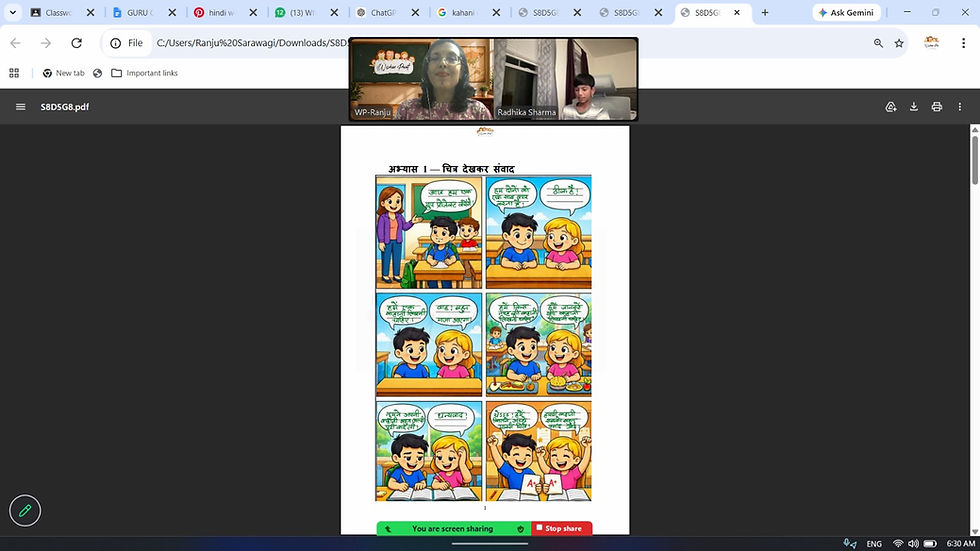


An insightful blog on the negative impact of AI. The role of Wisdom Point mentorship as a balancing force is clearly and thoughtfully highlighted.