


Narrative Writing: How to Plan, Write and Improve a Story


Every student is asked to write a story at some point, and almost every student finds the middle harder than the beginning. This guide shows you how narrative writing works, how to plan a story that builds, and how to make readers feel what your characters feel. Inside you will find a step-by-step method, a model story with notes, a rubric, a checklist and 30 original prompts for Grades 6 to 8.
The 30-Second Parent and Coach SummaryCore goal: A strong narrative follows one character through a clear problem to a meaningful change, and makes the reader feel that change rather than simply be told about it. What to praise • A first line that drops the reader straight into action, sound or a question. • At least one moment where a feeling is shown through what a character does or says, not named. • An ending that grows out of the character's own choice. Red flags to watch (and the gentle fix) • A list of events joined by "and then". Ask: "Which moment matters most? Slow that one down." • A story that opens with waking up or a page of background. Ask: "Where does the trouble start? Begin there." • A problem solved by luck, a rescue or a dream. Ask: "What could your character do to solve this?" |
What Is Narrative Writing?
Narrative writing is writing that tells a story, real or imagined, through a sequence of connected events. It uses characters, a setting, a conflict and a resolution to hold the reader's interest, and it brings the story to life with descriptive detail, dialogue and a clear point of view
Why we write narratives
A narrative entertains, but its deeper purpose is to let a reader experience something they have never lived through: a difficult choice, a moment of fear, a quiet change of heart. When a story works, the reader is not simply informed about what happened. They feel as if they were there.
Key features of narrative writing
• A main character with a goal: someone the reader can follow, who wants something.
• A setting: a time and place that shapes what can happen.
• A conflict: a problem or obstacle that stands in the character's way.
• A plot that builds: events that grow in tension towards a turning point, or climax.
• A resolution: the problem is settled, and the character has changed in some way.
• A point of view: the story is told from a chosen perspective (first person "I" or third person "she", "he", "they").
• Detail and dialogue: sensory description and speech that bring scenes to life.
Where you will use it
In school, narrative writing appears in creative writing tasks, coursework portfolios and timed English examinations. Beyond school, the same skills power novels, film and television scripts, magazine features, speeches that open with a story, and even university personal statements, where applicants tell the story of an experience that shaped them.
Who you are writing for
Your first reader is usually a teacher or examiner, but write as if for any curious reader of your own age. That reader wants to be drawn in quickly, kept guessing, and left with something to think about.
Narrative writing compared with similar forms
Feature | Narrative | Descriptive | Recount |
Main purpose | To tell a story that builds tension and shows change | To create a vivid picture of a person, place or moment | To retell real events in the order they happened |
Conflict | Essential: the story depends on it | Not needed | Optional and usually mild |
Structure | Opening, rising action, climax, falling action, resolution | Organised by focus (zooming in, moving through a space, the senses) | Chronological: first, next, then, finally |
Typical length of time covered | Often a few minutes or hours, told in scenes | A single moment, stretched out | Can span a day, a trip or longer |
Example | A volunteer must decide how to help an injured seabird | A harbour at dawn, described in detail | An account of a school trip to a castle |
How to Write a Narrative in 7 Steps
At Wisdom Point, we teach narrative writing as a process of decisions rather than inspiration. Each step below is shown using the same story, so you can watch one piece being built from the first idea to the final line. You can read the finished version in the Model Story section further down.
Step 1: Start with a want and an obstacle
A story begins when a character wants something and cannot easily get it. Before you think about plot, write one sentence that names both.
In our story: Marisol, a young volunteer at a seabird rescue centre, wants to help an oiled gannet. The obstacle: the vet is away, and the obvious way to help would harm the bird.
Step 2: Choose your point of view and tense
Decide who tells the story and when. First person ("I") feels close and personal. Third person limited ("she") lets you stay close to one character while describing them from outside. Past tense is the most common choice; whichever you pick, keep it consistent.
In our story: Third person limited, past tense. The reader sees only what Marisol sees and knows only what she thinks.
Step 3: Plan five story beats
Map your story onto five beats before drafting: opening, rising action, climax, falling action and resolution. Keep it to one or two lines each. This stops the middle from wandering and the ending from rushing.
In our story: Opening: a fisherman brings in the bird. Rising action: Marisol is tempted to wash it. Climax: she reads the safety card and chooses to wait. Falling action: the anxious phone call and the long half hour. Resolution: the vet confirms she made the right choice.
Step 4: Open with a hook that drops the reader in
Begin at the moment something changes, not at breakfast. A strong opening line uses action, sound, dialogue or a surprising detail to raise a question the reader wants answered.
In our story: "The fish box was still dripping when Davey Rowe set it on the counter, and something inside it hissed." The reader immediately wants to know what is in the box.
Step 5: Build the middle with scenes, not summary
A scene happens in real time, with action, detail and often dialogue. A summary covers time quickly. Use scenes for the moments that matter and summary to move past the moments that do not. This control of speed is called pacing.
In our story: The moment Marisol reads the safety card is slowed right down, word by word. The thirty-minute wait is covered in four sentences.
Step 6: Bring it to life with detail and dialogue
Choose a few precise sensory details rather than many general ones, and show feelings through actions instead of naming them. Every line of dialogue should either reveal character or raise tension.
In our story: Instead of "Marisol was nervous", the story shows "She dialled Dr Vos with fingers that would not quite keep still."
Step 7: End with change, then revise in two passes
The ending should settle the problem and show how the character has changed. Then revise twice. Pass one is for the story: does every scene earn its place? Pass two is for sentences: precise verbs, consistent tense and correct dialogue punctuation.
In our story: Marisol realises that bravery can mean knowing when to wait. In revision, "she put the towel over the box" became "she draped a second towel over the box".
Narrative Writing Structure: The Story Mountain
Most narratives follow a shape called the story mountain (also known as Freytag's pyramid). Tension climbs steadily, peaks at the climax, then settles as the story resolves. The percentages below are a guide for a short story of 450 to 650 words, not a rule.
Part | Purpose | What it contains | Approximate share |
Opening | Hook the reader and set up the situation | A strong first line, the main character, the setting, a hint of the problem | 10 to 15% |
Rising action | Build tension | The problem develops; obstacles grow; the character tries and struggles | 35 to 40% |
Climax | Reach the turning point | The moment of greatest tension, where the character must act or decide | 15 to 20% |
Falling action | Show the consequences | What happens as a result of the decision; tension begins to ease | 10 to 15% |
Resolution | Close the story with meaning | The problem is settled; the character has changed; a final image or thought | 10 to 15% |
The shape at a glance
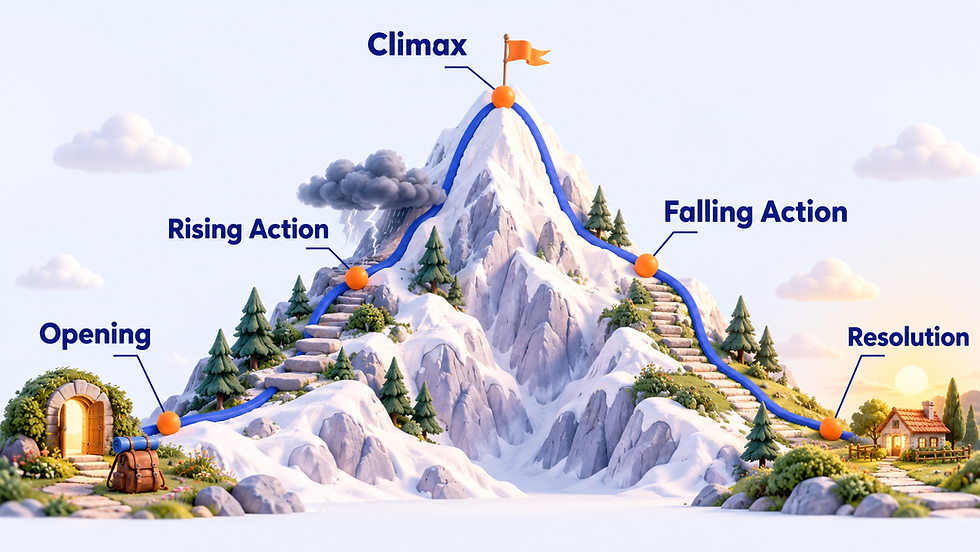
Planning organiser
Copy and complete this before you start drafting.
Story element | Your plan |
My main character is ________, who wants ________. |
|
The story takes place in ________ at/during ________. |
|
The problem begins when ________. |
|
Things get harder because ________ and ________. |
|
The moment of greatest tension is when ________. |
|
My character decides or realises ________. |
|
By the end, my character has changed because ________. |
|
Point of view: ________ Tense: ________ |
|
My opening line: ________ |
|
Five questions to answer before you write
1. What does my character want, and why does it matter to them?
2. What is the single moment my whole story is building towards?
3. Which one or two scenes deserve to be slowed down?
4. What will my character do, by their own choice, to resolve the problem?
5. What is different about my character, or their situation, by the last line?
Narrative Writing Vocabulary, Sentence Starters and Transitions
Strong vocabulary in a story is about precision, not length. One exact word usually does more work than three impressive ones. The word banks below are grouped by the job they do in a narrative.
Story job | Useful words and phrases |
Moving through time | moments later, by the time, meanwhile, that evening, at first, without warning, until, as soon as, for the next hour, long after |
Sight | glinting, streaked, smeared, dim, flickering, hazy, pale, mottled |
Sound | rasping, crackled, thudded, hummed, rattled, a low murmur, the scrape of |
Smell and taste | briny, smoky, sour, musty, sharp, metallic, sweet with |
Touch | clammy, gritty, slick, brittle, numb, prickling |
Speech verbs (use sparingly; "said" is often best) | muttered, insisted, admitted, called, whispered, snapped, asked, replied |
Building tension | for a moment nothing happened; just as; before she could; the silence stretched; then, quite clearly, |
Showing emotion | her stomach dropped; he stared at the floor; she let out a breath; his jaw tightened; her voice came out smaller than she meant |
Sentence starters
• Without warning, ...
• By the time she reached ..., ...
• Only then did he realise ...
• For a moment, nobody ...
• Somewhere behind them, ...
• Before she could ..., ...
• It was the sound that ...
• Even now, years later, ...
• As the ... faded, ...
• Nobody had told him that ...
Instead of ... try
Instead of | Try | When it fits |
She went to the door. | She hurried / crept / trudged to the door. | Choose the verb that shows mood: hurried (urgent), crept (afraid), trudged (tired). |
He said angrily. | He snapped. | A precise speech verb replaces the verb plus adverb. |
She was very scared. | Her hands would not stop shaking. | Show the feeling through the body or an action. |
He looked at the map. | He studied / glanced at / peered at the map. | Studied (careful), glanced (quick), peered (hard to see). |
It was a nice day. | The sky was pale and still, without a breath of wind. | Replace a vague judgement with a specific detail. |
Suddenly, ... | Start with the action itself: "The door slammed." | An abrupt sentence creates surprise better than the word "suddenly". |
Then ... then ... then ... | Moments later; By the time; or cut the link entirely. | Vary the links, or let one action follow another without a connector. |
A big building. | A towering / sprawling / squat building. | Each adjective gives a different shape. |
Common Mistakes Students Make in Narrative Writing
❌ Don't | ✅ Do Instead |
Open with your character waking up, or with a paragraph of background. "Sam woke up, brushed his teeth and had breakfast." | Open at the moment something changes. "The phone buzzed twice before Sam realised the message was from the coach." |
List events joined by "and then". | Choose the most important moments and turn them into scenes with action, detail and dialogue. |
Crowd the story with too many characters. | Keep to two or three characters who each have a role in the problem. |
Name feelings directly. "She was nervous." | Show them through action, body language or speech. "She checked the time for the third time in a minute." |
Write dialogue that simply chats. "Hi." "Hi, how are you?" "Fine." | Make every line reveal character or raise tension, and cut greetings and small talk. |
Let luck, a rescuer or a dream solve the problem. | Let your main character solve it, or fail, through their own choice. |
Slip between past and present tense. | Choose one tense in your plan and check every verb in your second revision pass. |
Run dialogue together in one paragraph. | Start a new line for each new speaker and place punctuation inside the quotation marks. |
Stop suddenly, or end with "It was all a dream". | End by showing what has changed: a decision, a realisation or a final image. |
Narrative Writing Checklist
Read your draft once for each group. Tick each statement only when it is true.
Group | I have ... | ✓ |
Content | given my main character a clear goal and a real obstacle. |
|
Content | chosen details that help the reader picture the setting. |
|
Content | let my character solve or face the problem through their own choice. |
|
Structure | opened at a moment of change with a strong first line. |
|
Structure | built tension towards one clear climax. |
|
Structure | slowed down the most important moment and summarised less important time. |
|
Structure | ended by showing how my character or situation has changed. |
|
Language | shown at least two feelings through action or speech instead of naming them. |
|
Language | used precise verbs and included more than one sense. |
|
Language | varied the length and openings of my sentences. |
|
Conventions | kept the same tense and point of view throughout. |
|
Conventions | started a new line for each speaker and punctuated dialogue correctly. |
|
Conventions | checked spelling, capital letters and paragraphing. |
|
Narrative Writing Rubric (4-Point Scale)
Teachers, tutors and parents can use this rubric to assess a story. Students can use it to judge their own draft before handing it in.
Criteria | 4: Exemplary | 3: Strong | 2: Developing | 1: Emerging |
Ideas and Content | Built around one clear, original problem; every scene moves the story forward; details are carefully chosen. | A clear problem drives the story; most details are relevant and some are vivid; one scene may drift. | A problem exists but appears late or is unclear; events are listed more than developed; details are general. | No clear problem or direction; events feel disconnected or borrowed from familiar stories. |
Structural Organisation | Opens at a moment of change; tension builds to a clear climax; pacing slows for key moments; the ending resolves the problem and shows change. | Clear beginning, middle and end with a recognisable climax; pacing mostly controlled. | Sequence can be followed but is uneven: a slow start, rushed climax or abrupt ending; relies on "and then". | Hard to follow; no clear climax; the story stops rather than ends. |
Vocabulary and Tone | Precise verbs and specific nouns create clear pictures; sensory detail goes beyond sight; tone suits the mood throughout. | Mostly precise word choice with some vivid sensory detail; tone generally consistent. | Word choice often general (nice, went, big); little sensory detail; tone shifts without purpose. | Very limited or repetitive vocabulary; little sense of mood. |
Sentence Fluency and Variety | Sentence length and openings varied deliberately, with short sentences at tense moments; dialogue sounds natural. | Good variety of sentence length and openings; dialogue mostly natural. | Some variety, but patterns repeat (many sentences start with "I" or "Then"); dialogue feels stiff. | Sentences mostly the same length and pattern, or run together in ways that confuse. |
Conventions | Tense and point of view held consistently; dialogue correctly punctuated with new lines for new speakers; very few errors. | Minor errors that do not distract; dialogue punctuation and tense mostly correct. | Frequent errors, including tense slips or dialogue punctuation, that sometimes distract. | Errors throughout make the story hard to read. |
Genre Fidelity and Audience Awareness | Clearly a story, not a recount: character, setting, conflict and resolution work together; feelings are shown; the ending leaves the reader thinking. | All core story elements are present; some feelings shown; the reader stays engaged for most of the piece. | Some story elements thin or missing; mostly telling; reads more like a recount. | Few narrative features; reads as a list, summary or description. |
Scoring guide (out of 24): 21 to 24 Exemplary | 16 to 20 Strong | 11 to 15 Developing | 6 to 10 Emerging
Narrative Writing Example: Annotated Model Story (Grades 6 to 8)
The prompt (Tier 3, Prompt 21)Write a story about a character who is left in charge of something important and must make a decision without help. Your story will appear in a magazine for readers aged 11 to 14. Write 450 to 650 words in 45 minutes. |
Warm, Dark and Quiet
The fish box was still dripping when Davey Rowe set it on the counter, and something inside it hissed. [1]
"Found him on the slipway at Seahouses," Davey said, pulling off his cap. "Covered in muck. Couldn't fly."
Marisol Brennan looked at the clock above the intake desk. Eleven fifteen. Dr Vos had driven to Alnwick for supplies twenty minutes ago, and the other volunteer had phoned in sick. For the next hour, Kittiwake Point Seabird Rescue belonged to a thirteen-year-old with a clipboard. [2]
She lifted the lid an inch. A gannet glared up at her, its pale blue eye ringed in black. Its white feathers were streaked with something thick and brown that smelled like a garage floor. [3] The bird stabbed at the gap, and Marisol snatched her hand back.
"Oil," Davey said. "Poor thing. You'll clean him up, then?"
Every part of her wanted to say yes. There was washing-up liquid under the sink and a tub big enough for a gannet. She had watched Dr Vos wash a guillemot only last month, the bird blinking in clouds of warm suds. How hard could it be? [4]
Her eyes went to the laminated card pinned beside the phone. She had read it so many times on quiet afternoons that she barely saw it any more. Now she read every word. [5]
OILED BIRDS: DO NOT WASH. DO NOT FEED. KEEP WARM, DARK AND QUIET. CALL THE VET.
"Not yet," she said. Her voice came out smaller than she meant it to.
Davey frowned. "He's freezing."
"I know. That's why." She was already moving. Marisol carried the box to the recovery room, switched the heat pad to low and slid it beneath a folded towel. Then she draped a second towel over the box until only a slit of light showed at one corner. The hissing faded to a rasping breath. [6]
She dialled Dr Vos with fingers that would not quite keep still.
"Is he alert?" Dr Vos asked.
"Very. He tried to take my thumb off."
A short laugh crackled down the line. "Good sign. Have you washed him?"
"No. The card says not to."
There was a pause long enough for Marisol to wonder whether she had got it all wrong.
"Well done," Dr Vos said at last. "Washing a cold, stressed bird can kill it. They need time to get their strength back first. I'll be there in thirty minutes. Keep him dark."
For the next half hour, Marisol sat on an upturned crate outside the recovery room, listening. Twice she stood up to check, and twice she sat down again without lifting the towel. Davey made her a cup of tea that she forgot to drink.

When Dr Vos finally hurried in, she lifted the corner of the towel, studied the bird for a long moment and let it fall.
"Breathing's steady," she said. "His temperature's coming up. You've given him a real chance."
Marisol let out a breath she felt she had been holding since eleven fifteen.
That evening, cycling home along the coast road, she watched a line of gannets fold their wings and drop into the grey water like thrown darts. She had always thought that being brave meant doing something. Today, it had meant knowing when to wait. [7]
(544 words)
Why This Model Works
Marker | Technique | Where it is taught |
[1] "...and something inside it hissed." | Opening hook. The story starts at the moment of change and uses a sound to raise an immediate question: what is in the box? | Step 4 |
[2] "...belonged to a thirteen-year-old with a clipboard." | Fast, purposeful set-up. In three sentences the reader learns the setting, why Marisol is alone and what is at stake. The backstory takes one line. | Structure: Opening |
[3] "...smelled like a garage floor." | Sensory detail beyond sight. An unexpected, everyday smell makes the oil real without technical description. | Vocabulary: Smell and taste |
[4] "How hard could it be?" | Internal conflict shown, not stated. A question in Marisol's head reveals her temptation and sets up the climax. | Step 1 |
[5] "Now she read every word." | Pacing at the climax. The story slows to a word-by-word reading of the card, stretching the moment of decision. | Step 5 |
[6] carried, switched, slid, draped | Precise verbs and varied sentences. A run of exact action verbs shows calm competence, followed by a short sentence as the tension eases. | Vocabulary; Sentence Fluency |
[7] "...knowing when to wait." | Ending that shows change. The diving gannets echo the opening, and the last line shows how Marisol's idea of bravery has changed, without a lecture. | Step 7 |
Rubric note: This story scores 4 for Genre Fidelity because every core element works together: a character with a clear want, a believable obstacle, a climax decided by her own choice, and a resolution that shows change. Feelings are shown through action and speech throughout.
30 Narrative Writing Prompts for Grades 6 to 8
The prompts are arranged in three tiers. Start with Tier 1 to build confidence, move to Tier 2 to stretch your thinking, and use Tier 3 to practise under exam conditions.
Tier 1: Starter Prompts
1. A parcel arrives addressed to someone who moved out of your character's flat years ago. Write the story of how they try to return it.
2. Your character's working model breaks five minutes before they must present it at a science fair. Write what happens in those five minutes.
3. Halfway through a race, a swimmer realises she has misheard the distance. Write the rest of the race from her point of view.
4. A character gets off a tram one stop too early in a city they do not know and has forty minutes to reach a concert hall.
5. During an orchestra rehearsal, every light in the hall goes out. Write the story of the ten minutes that follow.
6. A retired train driver asks his grandchild to help record his memories for a museum exhibition. Write the story of the first recording session.
7. On an astronomy club evening, the telescope is ready, but the only person who knows how to use it has gone home ill.
8. Two friends run a weekend bike-repair stall at a market. On their busiest day, they make a mistake with a customer's bike.
9. During a garden bird count, a character spots a bird that should not be anywhere near their town. Nobody believes them.
10. A character is chosen to cut the ribbon at the opening of a new footbridge, then notices something wrong minutes before the ceremony.
Tier 2: Deep Thinking Prompts
1. Write a story narrated by a character who believes they are the hero, although the reader may judge their actions differently.
2. Tell the same five minutes twice: once from the view of a referee who makes a disputed decision, and once from the player affected.
3. A character discovers that the online vote for the student council can easily be changed. Their best friend is losing. Write the story of their decision.
4. A first-aid volunteer at a city marathon must decide whether to stop a runner who insists they are fine.
5. Set a story in a real historical period of your choice, in which an ordinary person witnesses an event that later becomes famous, without realising its importance at the time.
6. Write a story that begins with its final scene, then moves back in time to show how the character got there.
7. A character's experiment, months in the making, is ruined the day before the results are due. Focus on what the character does next, not on the disaster itself.
8. A character campaigns to save a community swimming pool from closure and discovers that the person most opposed has a reason worth hearing.
9. Write a story about a friendship that changes because of a single message sent at the wrong moment.
10. A character enters a sculpture competition using only materials from a recycling centre. Halfway through, a rival asks for help.
Tier 3: Exam-Style Prompts
Each prompt states the audience, purpose, length and suggested time. Plan for the first five minutes and keep five minutes at the end to check your work.
1. Write a story about a character who is left in charge of something important and must make a decision without help. Audience: readers of a magazine for 11 to 14 year olds. Purpose: to entertain and show change. Length: 450 to 650 words. Time: 45 minutes. (Answered by the Model Story above.)
2. Write a story that begins with this sentence: "The announcement came over the speakers just as the train entered the tunnel." Audience: readers of your school's creative writing anthology. Purpose: to build suspense. Length: 450 to 650 words. Time: 45 minutes.
3. Write a story with the title "The Second Attempt". Audience: judges of a regional young writers' competition. Purpose: to entertain and move the reader. Length: 500 to 700 words. Time: 50 minutes.
4. Write a story inspired by this scene: an empty sports hall, a single trainer in the middle of the court and a scoreboard that still shows the final score. Audience: your English teacher. Purpose: to create mystery. Length: 450 to 650 words. Time: 45 minutes.
5. Write a story in which a misunderstanding between two people is resolved by the end. Audience: your classmates. Purpose: to entertain and show how a relationship changes. Length: 450 to 600 words. Time: 40 minutes.
6. Write a story set during a storm, in which the weather is not the main problem. Audience: an examiner. Purpose: to show control of setting and conflict. Length: 450 to 650 words. Time: 45 minutes.
7. Write a story that ends with this line: "And that was the last time anyone called it impossible." Audience: readers of a school newsletter. Purpose: to inspire. Length: 450 to 650 words. Time: 45 minutes.
8. Write a story about a character who crosses a line they have never crossed before. You may interpret "line" literally or figuratively. Audience: an examiner. Purpose: to explore a turning point. Length: 500 to 700 words. Time: 50 minutes.
9. Write a story in three linked sections that follows one object as it passes through three different owners. Audience: readers of a young people's fiction website. Purpose: to connect separate lives. Length: 550 to 700 words. Time: 50 minutes.
10. Write a story about a team that loses, in which losing turns out to matter more than winning would have. Audience: readers of a sports club magazine. Purpose: to entertain and reflect. Length: 450 to 650 words. Time: 45 minutes.
Narrative Writing: Frequently Asked Questions
What are the five elements of narrative writing?
The five elements of narrative writing are character, setting, plot, conflict and theme. Character and setting tell the reader who and where, plot and conflict drive the events, and theme is the idea the story leaves behind.
What is the difference between narrative and descriptive writing?
Narrative writing tells a story with a conflict that builds and resolves over time. Descriptive writing creates a detailed picture of a person, place or moment and does not need a plot or a problem, although good narratives use descriptive detail.
How long should a narrative be for Grades 6 to 8?
Timed classroom and exam narratives at this level are commonly around 400 to 700 words. Coursework stories can be longer, but a focused story with one clear problem usually scores better than a long one that wanders.
How do you start a narrative essay?
Start a narrative at the moment something changes, using action, a sound, a line of dialogue or a surprising detail. Avoid opening with waking up or a long introduction, and bring in background information only when the reader needs it.
Is a personal narrative the same as narrative writing?
A personal narrative is one type of narrative writing in which the writer tells a true story from their own life, usually in the first person. It uses the same elements as any narrative, including conflict, detail and change, but the events really happened.
Your Next Step
Pick one Tier 1 prompt and plan it using the organiser above before writing a single sentence of the story. When you have a draft, check it against the checklist, then score it with the rubric. To sharpen the detail in your scenes, read our guide to Descriptive Writing next.
Want expert feedback on your child's writing? Wisdom Point's one-to-one writing programme helps students in Grades 3 to 12 plan, draft and revise with a specialist tutor, with detailed feedback on every piece. Book a free writing assessment at www.wisdom-point.org. |


Comments