


Informal Letter Writing: Format, Samples and Tips

WISDOM POINT · STUDENT WRITING FORMATS

QUICK ANSWER An informal letter begins with your address and the date at the top left, followed by a warm greeting such as Dear Emma. Write three friendly paragraphs: open by asking how the reader is, share your news in the middle, and close warmly. Sign off with an affectionate phrase such as With love, followed by your first name. Unlike a formal letter, it has no receiver's address and no subject line. |
An informal letter is the warmest kind of writing there is. It is what you send to a friend, a cousin, or a grandparent, and its whole purpose is to keep a bond alive across any distance. In an age of quick messages, a real letter still feels special, and learning to write one well is a gift a child can give for the rest of their life. At Wisdom Point, we teach informal letter writing with as much care as the formal kind, because warmth on the page is a skill in its own right.
This guide explains the informal letter format, walks you through it step by step, and shares two full samples. You will also find tips, common mistakes to avoid, and answers to the questions students ask most. The format is cross checked against the major curricula so it works wherever your child studies.
What Is an Informal Letter?
An informal letter is a personal, friendly letter written to someone you know well. The tone is warm and conversational, and you write much as you would speak. You might share news, say thank you, describe an experience, or simply keep in touch. There is no need to be stiff or official, because the reader is someone you care about.
The Informal Letter Format
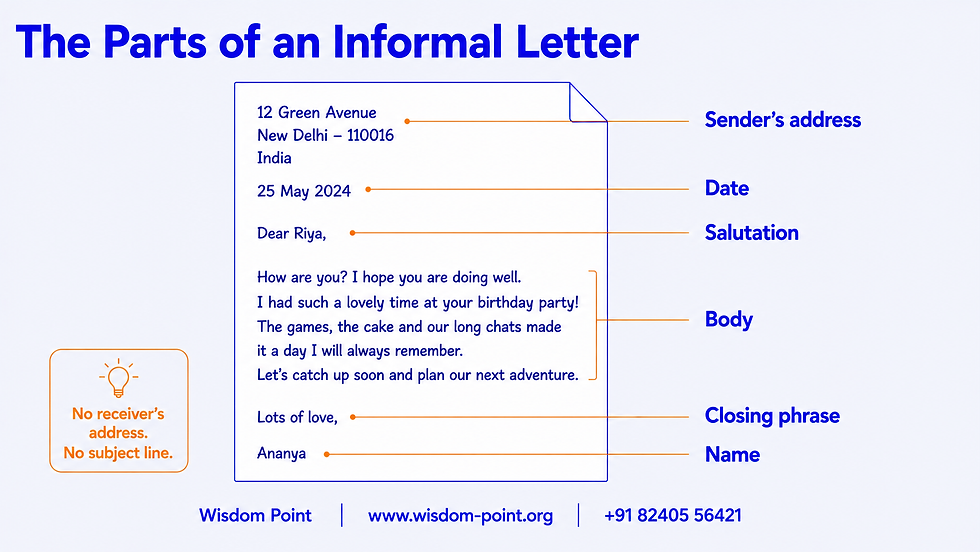
An informal letter has a simple, friendly shape. The most important thing to remember is what it does not have: unlike a formal letter, there is no receiver's address and no subject line.
Part | What it is | Example |
Sender's address | Your address, top left, each line separate. | 14 Maple Street, Riverside |
Date | Below the address, written in full. | 20 June 2026 |
Salutation | A warm, affectionate greeting. | Dear Emma, |
Body | Three paragraphs: greeting, news, warm goodbye. | I hope this letter finds you well... |
Closing phrase | An affectionate sign off. | With love, |
Name | Your first name. | Olivia |
HOW THIS FORMAT WORKS ACROSS BOARDSInformal letter writing is part of CBSE, ICSE and most school curricula, and it has its own warm conventions. CBSE and ICSE expect the sender's address, the date, a friendly salutation, a three-paragraph body and an affectionate close, but no receiver's address and no subject line. IGCSE and IB reward a consistent friendly register, while US Common Core values writing that matches its reader. One simple format works across them all, which is why Wisdom Point teaches a single clear version your child can use anywhere. |
How to Write an Informal Letter Step by Step
1. Write your address at the top left, with the date just below it.
2. Greet your reader warmly, using Dear and their first name or your name for them, such as Dear Emma or Dear Grandma.
3. Open the first paragraph in a friendly way. Ask how they are, or thank them for their last letter.
4. Share your news in the middle paragraph, in a natural, chatty voice with personal details.
5. Close the final paragraph warmly. Send your regards and invite them to write back.
6. Sign off with an affectionate phrase such as With love or Your loving friend, then your first name.
Informal Letter Sample 1: A Letter to a Friend
Here is a complete informal letter to a friend, sharing news about a family trip. Notice the address and date at the top, the warm greeting, the three friendly paragraphs, and the loving sign off. There is no receiver's address and no subject line.
SAMPLE 1 14 Maple Street Riverside 20 June 2026 Dear Emma, I hope this letter finds you well. It has been far too long since we last wrote, and I have been thinking about you and wondering how your new school is treating you. I had to tell you about the camping trip my family took last weekend. We drove up to the lake on Friday and pitched our tent right by the water. On the second night we sat around the fire and watched the most incredible sky full of stars, more than I have ever seen. I even spotted a shooting star and made a wish, though I will not tell you what it was. Do write back soon and tell me all your news. I miss our long chats. Give my love to your family. With love, Olivia |
Informal Letter Sample 2: A Letter to a Grandparent
This second sample is a thank-you letter to a grandparent. The tone is just as warm, and it follows exactly the same format.
SAMPLE 2 9 Cedar Close Hilltown 2 May 2026 Dear Grandma, Thank you so much for the wonderful birthday present. The painting set was exactly what I had been hoping for, and you always seem to know what will make me happiest. I have already used it to paint the view from my window, and Mum has put my first picture on the fridge. School is going well too. I came second in the science fair last week with a project about how plants drink water, and my teacher said my display was the neatest in the class. I hope your garden is blooming and that your knee is feeling better. We are all looking forward to visiting you in the summer. Please take good care of yourself. With love, Noah |

Tips for Writing an Informal Letter
• Write the way you speak to the person, with warmth and personality.
• It is fine to use contractions such as I'm and you'll. They keep the letter friendly.
• Keep three clear paragraphs: a friendly opening, your news, and a warm goodbye.
• Add small, personal details that show you are writing to this person in particular.
• End by asking them to write back, so the letter feels like part of a conversation.
Common Mistakes to Avoid
• Adding a receiver's address or a subject line, which belong only in formal letters.
• Sounding stiff or official when writing to someone you love.
• Forgetting the sender's address and the date at the top.
• Writing one long block instead of three friendly paragraphs.
• Forgetting an affectionate closing phrase before your name.
Informal Letter or Formal Letter: What Is the Difference?
The two look similar at a glance, but the differences matter. A formal letter has a receiver's address, a subject line, and a close such as Yours faithfully. An informal letter has none of these. Instead it uses a warm greeting like Dear Emma and an affectionate close like With love. You can read our full guide to the formal letter format to see the contrast clearly.

Frequently Asked Questions
What is the format of an informal letter?
An informal letter has the sender's address, the date, a warm salutation, a body of about three paragraphs, an affectionate closing phrase, and your first name. It has no receiver's address and no subject line.
How do you start an informal letter?
Start with your address and the date at the top left, then a warm greeting such as Dear Emma or Dear Grandma. Open the first paragraph by asking how the person is or thanking them for their last letter.
How is an informal letter different from a formal letter?
An informal letter is warm and personal, with no receiver's address and no subject line, and it uses affectionate greetings and closings. A formal letter is official, with a receiver's address, a subject line, and closings such as Yours faithfully.
How do you end an informal letter?
End with an affectionate closing phrase such as With love, Lots of love, or Your loving friend, followed by your first name.
How many paragraphs should an informal letter have?
An informal letter usually has three paragraphs: a friendly opening, the main news, and a warm closing.
Can you use contractions in an informal letter?
Yes. Contractions such as I'm and you'll are natural in an informal letter and help it sound friendly and personal.
KEY TAKEAWAYS An informal letter is warm and personal, for friends and family. It has the sender's address and date, but no receiver's address and no subject line. Write three paragraphs: a friendly opening, your news, and a warm goodbye. Close with an affectionate phrase such as With love, then your first name. The same format works across CBSE, ICSE, IGCSE, IB and Common Core. |
A warm, well-written letter can mean more to the person who receives it than any quick message ever could. Teach your child this format, and you give them a way to stay close to the people they love, wherever life takes them.
LEARN TO WRITE WITH WISDOM POINT From friendly letters to formal applications, Wisdom Point helps young writers find the right voice for every reader. Our English and Creative Writing programmes guide students across the USA, UK, UAE, Singapore, Canada, Australia and beyond, with every format checked against CBSE, ICSE, IGCSE, IB and Common Core. To enrol or to find the right programme for your child, visit www.wisdom-point.org or call +91 82405 56421. Come and write with us. |


A beautiful example of how the right guidance can transform learning into a creative experience.