


Paragraph Writing: Format and Examples for Students

WISDOM POINT · STUDENT WRITING FORMATS

QUICK ANSWER A paragraph is a group of sentences about one main idea. It has three parts: a topic sentence that states the idea, supporting sentences that give details and examples, and a concluding sentence that rounds it off. Keep every sentence connected to the main idea, and use linking words to guide the reader. |
The paragraph is the building block of almost everything a student writes. Stories, essays, letters, emails and reports are all made of paragraphs, so a child who can write one well has a foundation for every other kind of writing. That is exactly why Wisdom Point teaches paragraph writing early and carefully, because getting this one skill right makes every later task easier.
This guide explains what a paragraph is, the three parts it is built from, and how to write one step by step. You will find two full example paragraphs with breakdowns, the main types of paragraphs, practical tips, common mistakes, and answers to the questions students ask most.
What Is a Paragraph?
A paragraph is a group of sentences that develop a single main idea. When that idea is complete, the paragraph ends, and a new paragraph begins for the next idea. This is why a well-organised piece of writing is broken into paragraphs rather than written as one long block. Each paragraph gives the reader one clear idea at a time.
The Three Parts of a Paragraph
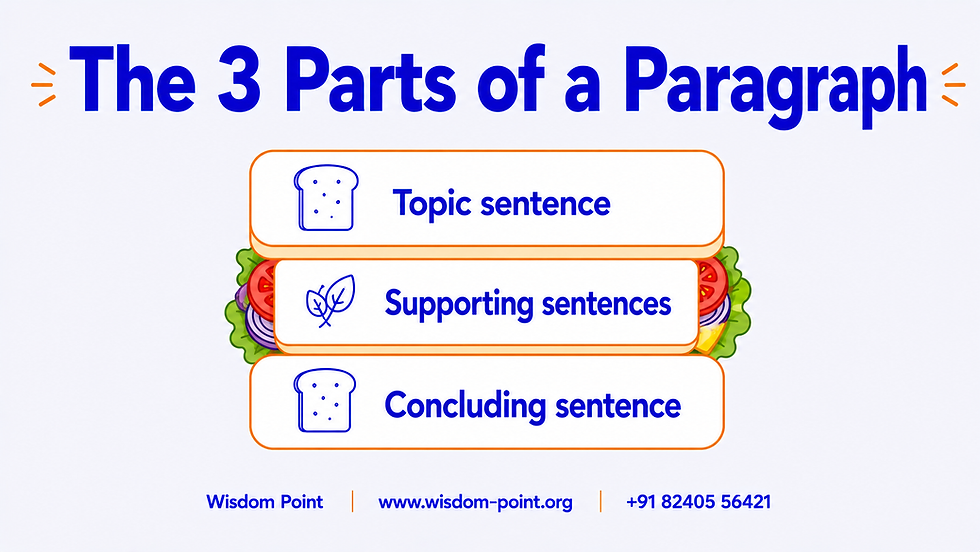
A strong paragraph is built from three parts. Many teachers picture it as a sandwich: the topic sentence and the concluding sentence are the two slices of bread, and the supporting sentences are the filling in between.
Part | What it does |
Topic sentence | States the main idea, usually the first sentence. |
Supporting sentences | Give details, examples, reasons or evidence. |
Concluding sentence | Rounds off the idea and closes the paragraph. |
HOW THIS FORMAT WORKS ACROSS BOARDSParagraph writing is the foundation of nearly every writing task, so every curriculum builds on it. CBSE and ICSE expect a clear topic sentence, relevant supporting detail, and a sense of completeness. IGCSE and IB value unity, coherence and well-linked ideas. US Common Core asks students to develop a topic with facts, details and examples, and to use linking words to connect ideas. The structure below meets all of them, which is why Wisdom Point teaches one clear, reliable model. |
How to Write a Paragraph Step by Step
1. Choose one main idea. A paragraph should be about a single idea, not several.
2. Write a topic sentence that states that idea clearly.
3. Add supporting sentences with details, examples, or reasons.
4. Keep every sentence connected to the main idea, so the paragraph stays unified.
5. Use linking words to guide the reader, such as for example, because, however, and as a result.
6. End with a concluding sentence that rounds off the idea.
Example Paragraph 1: A Descriptive Paragraph
Here is a descriptive paragraph about a favourite place. Read it once, then see the breakdown below to spot the three parts.
Here is how the three parts appear in this paragraph.
Part | In this paragraph |
Topic sentence | The library quickly became my favourite place in the whole school. |
Supporting sentences | The quiet, the tall shelves, the soft lamp, and sitting there in the rain. |
Concluding sentence | I could not imagine a single week without that quiet corner. |
Example Paragraph 2: An Opinion Paragraph
This second paragraph shares an opinion and supports it with a reason and an example. It follows the same three-part shape.
EXAMPLE 2 Reading every day is one of the best habits a student can build. Children who read for pleasure tend to have larger vocabularies and stronger writing than those who do not. This makes sense, because every page introduces new words, ideas, and ways of putting sentences together. A reader absorbs all of this almost without trying, the way a sponge soaks up water. For this reason, even ten minutes of reading a day can make a real difference over a whole year. |
Part | In this paragraph |
Topic sentence | Reading every day is one of the best habits a student can build. |
Supporting sentences | The point about vocabulary, the reason behind it, and the sponge comparison. |
Concluding sentence | Even ten minutes of reading a day can make a real difference over a year. |
The Main Types of Paragraphs
Paragraphs can do different jobs depending on the task. These are the four most common types your child will be asked to write.
• Descriptive: paints a picture of a person, place or thing using the senses.
• Narrative: tells a small part of a story or describes an event in order.
• Expository: explains a topic or gives information clearly.
• Persuasive: argues a point and tries to convince the reader to agree.

Tips for Writing a Strong Paragraph
• Stick to one idea per paragraph. The moment a new idea begins, start a new paragraph.
• Open with your clearest sentence, the topic sentence, so the reader knows the point at once.
• Use linking words such as for example, in addition, however, and as a result to connect your sentences.
• Vary your sentence lengths so the paragraph does not feel flat.
• Read it back and remove any sentence that wanders away from the main idea.
Common Mistakes to Avoid
• Packing several different ideas into one paragraph.
• Forgetting a topic sentence, so the reader is unsure what the paragraph is about.
• Writing one very long sentence instead of several clear ones.
• Adding details that do not connect to the main idea.
• Never starting a new paragraph, so the whole piece becomes one block of text.

Frequently Asked Questions
What is a paragraph?
A paragraph is a group of sentences that develop one main idea. It usually has a topic sentence, several supporting sentences, and a concluding sentence.
What are the three parts of a paragraph?
The three parts are the topic sentence, which states the main idea, the supporting sentences, which give details and examples, and the concluding sentence, which rounds off the idea.
How many sentences should a paragraph have?
A paragraph usually has between three and seven sentences, but the exact number depends on the idea. What matters is that the idea is fully developed and the paragraph stays unified.
What is a topic sentence?
A topic sentence is the sentence that states the main idea of a paragraph. It usually comes first and tells the reader what the paragraph will be about.
How do you start a paragraph?
Start with a clear topic sentence that states the main idea, then follow it with supporting sentences that explain or give examples.
What is the difference between a paragraph and an essay?
A paragraph develops a single idea, while an essay develops a larger topic across several paragraphs, each with its own main idea, joined by an introduction and a conclusion.
KEY TAKEAWAYS A paragraph develops one main idea. It has three parts: a topic sentence, supporting sentences, and a concluding sentence. Keep every sentence connected to the main idea. Use linking words to guide the reader smoothly. The structure works across CBSE, ICSE, IGCSE, IB and Common Core. |
Master the paragraph and you have mastered the unit that every longer piece is made from. It is the quiet skill behind every confident writer, and it is well worth the time it takes to learn.
LEARN TO WRITE WITH WISDOM POINTStrong paragraphs are the foundation of every skill we build at Wisdom Point. Our English and Creative Writing programmes guide students across the USA, UK, UAE, Singapore, Canada, Australia and beyond, from a single clear paragraph to full essays and stories, with every skill aligned to CBSE, ICSE, IGCSE, IB and Common Core. To enrol or to find the right programme for your child, visit www.wisdom-point.org or call +91 82405 56421. Come and write with us. |


Your focus on interactive learning and conceptual clarity makes education more engaging and accessible for students.