


Why Stars Twinkle

“Twinkle, twinkle, little star...”
Most people know that famous line. But if you pause and peer into the night sky, the question naturally arises: Why do stars twinkle at all? Why do they twinkle and flash instead of shining steadily like little electric lights in the sky?
The answer is surprisingly near. The stars twinkle not because something is happening to the stars, but because of what happens to their light when it reaches the Earth.
And when you know the reason, the night sky is even more fascinating.
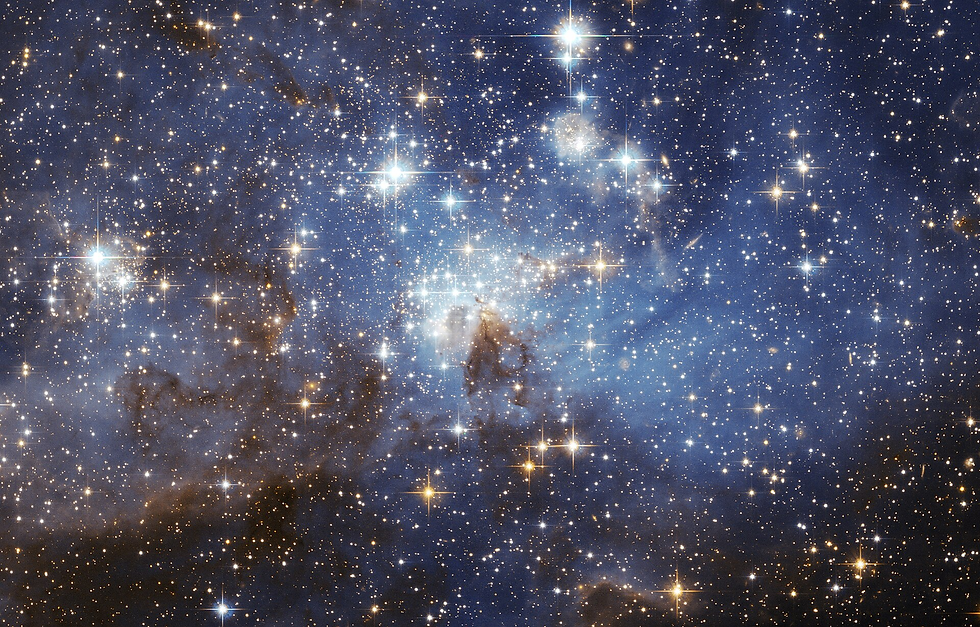
The Light of a Star Travels for Years
Every star is a large, bright ball of hot gas. Some are bigger than our Sun. Some are smaller. They are all unbelievably far away.
Take Proxima Centauri, for example, the closest star to the Sun. Even the light from it takes over four years to reach Earth. Light from most other stars takes hundreds or thousands of years to get to us.
Think about that for a second.
Some of the stars you look at tonight might have sent their light on its way before you were born.
For most of that journey, the light moves through space quite smoothly. Then it enters Earth’s atmosphere, and that is when the flickering begins.

Earth’s Atmosphere Never Stands Still
Even on a calm night, the air above us is always moving.
Warm air rises. Cooler air falls. Winds change direction. Some layers of air are thick, while others are thin. We do not usually notice these changes, but starlight does.
When starlight enters the atmosphere, it has to pass through these uneven layers. The light is bent a little by each layer. Scientists call this bending refraction.
The path of the light keeps shifting because the atmosphere changes from moment to moment. The star appears to wobble, brighten, dim, or sparkle.
That effect is called twinkling.
It is a bit like looking at a coin at the bottom of a swimming pool. If the water is still, the coin appears clear. But when the water ripples, the coin seems to dance and shimmer. The star itself has not changed, only the path of its light has.

Why Don’t Planets Twinkle Most of the Time?
Another interesting thing is that planets often look steadier than stars.
That is because stars and planets do not appear the same when viewed from Earth.
Stars are extremely far away, so they appear as tiny points of light. Even small changes in the atmosphere can disturb that narrow beam of light.
Planets are much closer. They still look small, but more like tiny disks than points. Their light spreads out more evenly, so it is less affected by atmospheric movement.
That is why planets shine steadily while stars twinkle.
In fact, many amateur sky watchers use this trick. If a bright object in the sky twinkles very little, it is probably a planet.
Stars Close to the Horizon Blink More
Have you ever noticed how stars near the horizon seem especially restless? Sometimes they flash rapidly in red, blue, or white colors.
That happens because their light has to travel through more of Earth’s atmosphere before reaching your eyes.
A star directly overhead passes through less air. A star near the horizon must pass through a much thicker layer of atmosphere. More atmosphere means more turbulence and more bending of light.
That is why the bright star Sirius is famous for strong twinkling. On some winter evenings, it twinkles so brightly that people mistake it for an aircraft.
You may have noticed a similar effect closer to home.
On very hot days, roads can appear wavy in the distance. Objects may also seem to shake above a candle flame or barbecue grill.
This happens because hot air bends light differently from cooler air.
Star twinkling works in a similar way. Earth’s atmosphere acts almost like moving glass, bending starlight again and again before it reaches your eyes.
Do Stars Twinkle in Outer Space?
No.
Astronauts aboard the International Space Station do not see stars twinkling the way we do on Earth. There is no thick atmosphere in space to bend the light. Starlight travels straight to their eyes.
That is one reason scientists place telescopes in space.
The Hubble Space Telescope was launched above Earth’s atmosphere so it could capture clearer pictures of the universe. More recently, the James Webb Space Telescope has taken incredibly sharp images of distant galaxies and nebulae.
From space, stars shine steadily and do not twinkle.
Twinkling Is Not Always a favourite of Astronomers
Most people think twinkling stars are beautiful. Astronomers sometimes disagree.
Earth’s atmosphere can blur images of distant objects, making it difficult for scientists to take perfectly clear photographs.
That is one reason many observatories are built on mountain tops where the air is thinner and steadier.
Chile and Hawaii are famous for excellent astronomy locations.
Modern telescopes also use a clever system called adaptive optics. Special mirrors adjust themselves many times every second to reduce atmospheric distortion. It is almost like correcting blurry vision instantly.
Long Ago, People Wondered About This Too
People admired the flickering night sky long before scientists understood the atmosphere.
Ancient travellers used stars for navigation. Farmers watched them to understand the changing seasons. Storytellers connected groups of stars to myths and legends.
Aristotle, the Greek thinker, believed that Earth’s air affected the appearance of stars. He was partly correct, although he did not know the complete explanation.
Even today, there is something timeless about standing outside and watching stars shimmer overhead.
A Little Spark, A Big Story
The next time you see a twinkling star, remember what it really means.
That tiny flicker is caused by layers of moving air above Earth bending light that may have travelled through space for hundreds or even thousands of years.
In a remarkable way, every twinkle is a meeting between the deep universe and our own planet.
Far away in space, stars shine with steady light. It is only when their light reaches Earth’s restless atmosphere that the sparkling begins.
And somehow, knowing that makes the night sky feel even more alive.
FAQs
1. Why do stars twinkle more in winter?
Cold winter air can sometimes create stronger atmospheric turbulence, especially on windy nights, causing stars to twinkle more noticeably.
2. Why do planets seem steadier than stars?
Planets are much closer to Earth, so they appear slightly larger in the sky and are less affected by atmospheric changes.
3. Do airplanes look like twinkling stars?
Yes. The bright lights of distant airplanes can sometimes look like stars at night. However, airplanes usually move slowly across the sky.
4. When stars twinkle, do they actually change brightness?
Not usually. The star itself remains steady. Earth’s atmosphere changes the way the light reaches our eyes.
5. What is the brightest star in the night sky?
The brightest star visible in Earth’s night sky is Sirius, also known as the “Dog Star.”


Comments